Path of the Gods Amalfi Coast: Walking the Trail, Revisited
The Amalfi Coast has been part of our work for as long as our company has existed. Positano, Sorrento, Ravello, Amalfi and Minori are among the destinations American advisors place clients in most consistently with us, and they have been since long before the recent boom seasons in southern Italy.
This is why our product team keeps going back to walk the coast on foot, every year, often more than once.
Coastal traffic patterns shift as the towns receive more visitors than their infrastructure was originally built for. Properties we have routed for a decade reorganize their service in ways that only register when you sit in their dining room for two nights running. The cook whose pasta our clients ask for by name may have moved on by the time we route the next group, and the shepherd whose table we send hikers to may have closed for a season we did not see coming. None of that information comes through in the email correspondence we run between visits, which is the reason a structured field agenda each spring is still part of how we work.
In April, our product specialist Laura spent three days on the Amalfi Coast on a fam trip organized by one of the boutique properties we work with most closely on this stretch of coast. The agenda included Positano, Sorrento, Ravello, Amalfi and Minori, alongside the trail that has come to define one segment of our advisor traffic in southern Italy: the Path of the Gods, Italy’s most photographed clifftop hike, known locally as the Sentiero degli Dei.
This post is her field report.
What You Will Find in This Report
Why Our Team Goes First
Site inspections on the Amalfi Coast are not about learning the territory for us. After almost two decades routing clients through Positano, Sorrento, Amalfi, Ravello and Minori, we know the coast as well as anyone in the trade does.
What three days on the ground are designed to do is more specific. Each property and operator currently sitting in our 2026 portfolio gets tested against the standard we need to hold on this stretch of coast: sometimes the visit confirms what we have been doing for years, sometimes a partnership needs adjustment to match how the property has evolved, and occasionally we conclude that an operator we placed in our offering several seasons ago no longer matches what we want for the year ahead, in which case we cut it without making a public note of it.
The same approach shaped our recent fieldwork in Sardinia’s interior and in the borderlands of Lunezia, as well as the wine estates of the Gavi DOCG in Piedmont this same spring. The Amalfi Coast in mid-April was the next item on a calendar we run all year.
“The Amalfi Coast is not a stretch of Italy we are getting to know for the first time, and the trip was not framed that way. What three days on the ground gave us was the chance to walk the trail more carefully than we had managed in recent visits, to sit with partners we usually only see during peak booking conversations, and to look closely at logistics that keep adjusting to visitor pressure the local infrastructure was never built to absorb.”
— Laura, See Italy Travel Product Team
The invitation came from one of the boutique properties we have been routing clients to consistently for several seasons. They had organized a fam trip for travel agents from 20 to 22 April 2026, and we joined to combine site re-inspection of the property with the broader Path of the Gods agenda over the same three days.
Our Approach
Our product team runs structured inspections across Italy through every season of the year. The work means confirming partnerships we have held for two decades, adjusting the ones that have shifted, and bringing in new ones only after spending real time on the ground with the people running them. The Amalfi Coast in spring 2026 was one stop among many: across a single year our coverage reaches Piedmont, Sardinia and Liguria in the north, southern Tuscany and Basilicata further down, and the corners of the south where the offering needs continuous attention to stay current.
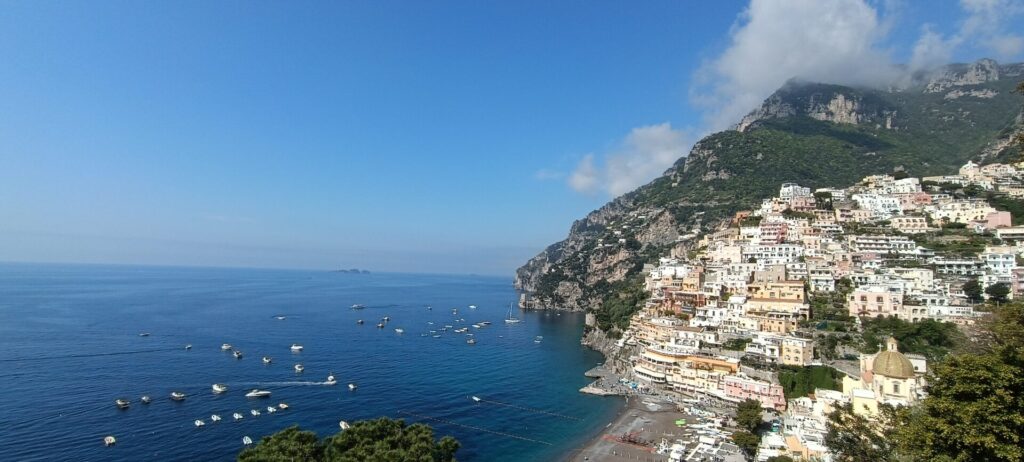
The Path of the Gods Italy: Where the Trail Sits on the Amalfi Coast Map
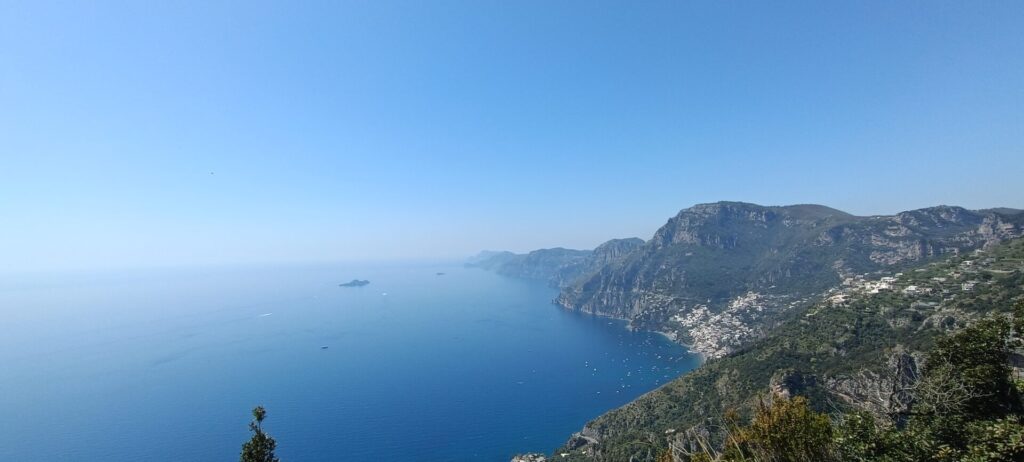
The Path of the Gods Italy, in Italian il Sentiero degli Dei, is a clifftop trail running roughly 7 kilometers along the upper ridge of the Amalfi Coast, between the village of Bomerano (in the comune of Agerola) and Nocelle, a hamlet of Positano sitting just above the town itself. The path runs at approximately 630 meters above sea level for most of its length, across a coastline that has held UNESCO World Heritage status since 1997.
Its name comes from local mythology, in a story still told in the bars of Agerola: the gods are said to have come down from Olympus along this ridge to save Ulysses from the sirens of the Li Galli, the small islets visible in the bay below the trail. Whether or not the legend really predates Italian historian Giustino Fortunato, who is credited with the modern name in the nineteenth century, the geometry of the route makes the story easy to believe. The coastline below the trail sweeps from Praiano westward all the way to Capri’s Faraglioni in a single uninterrupted view.
The trail can be entered from three points, although by a wide margin the most common start is Bomerano, which is the entrance we route for our clients. Praiano offers an alternative beginning further down the coast but requires a steep stair climb to reach the lower fork of the path. The third trailhead, at Santa Maria del Castello, opens onto the upper variant of the trail, which is less trafficked and rather more demanding in both elevation and exposure. The standard recommendation in published guides, for very good reason, is to walk Bomerano-direction-Nocelle as the easier of the two ridge orientations, and we agree with the same recommendation for hikers who are not specifically looking to test themselves on the climb.
The walking experience itself is what makes the trail famous. Visually, the panorama is among the longest uninterrupted stretches accessible on foot anywhere in southern Italy. The path is narrower than most published guides suggest, and reduces to single-file in the rockier sections. Underfoot, the terrain shifts between dirt path, stone steps, exposed rock, and shorter shaded sections through Mediterranean scrub. In mid-April, when our team walked it, the slopes were already bright with wild rosemary in flower and broom in full yellow, the first cistus had begun to open along the higher terraces, and the smell of wild fennel rose from the path wherever the ground opened up onto the cliff edge.
A Three-Day Assessment of the Trail and the Coast
The fam trip ran from 20 to 22 April 2026, with three days on the ground covering the trail itself, the coastal towns we route most often, and the property where the group was based. What follows is what we evaluated and what we took away.
The Hike Itself: The Loop We Run for Clients, and the Variant We Walked
The version of the trail we route for our clients is a loop. Pickup from the property by driver, transfer to Bomerano, and from there a walk along the ridge as far as the Refuge stop with Antonio at midday, then a return on the same path back to Bomerano where the driver is waiting. The loop covers around half of the published Bomerano-to-Nocelle route and takes approximately three hours of active walking. This is what we book as the standard product, and it is the version of the experience that most clients on this coast want.
The version Laura walked during the inspection was different. She covered the full Bomerano-to-Nocelle stretch with the guide arranged by Torre Sponda for the fam trip, and then continued on foot from Nocelle down to Positano on the public stair route. Her active walking time came in at around four hours including the lunch stop, plus a further hour on the descent. The descent itself, taken in full on foot, is roughly 1,800 stone steps in succession, and Laura’s verdict on it is direct: she would not put a client on those steps unless the client specifically asks and is genuinely fit for it. Our regular guide partner on this stretch confirmed the same when we compared notes afterward, and the public stair descent is not what he runs for clients either. The inspection version exists in this report because the role of an inspection visit is to test the harder edges of the trail, not the easier ones.
Mid-April conditions were as close to ideal as this trail offers. Daytime temperatures sat in the late teens Celsius (mid-sixties Fahrenheit), with light wind, dry ground, and the kind of clear air that kept Capri sharply visible on the horizon for most of the route. Spring also brought a vegetation cover the trail rarely shows in published photography, which tends to favor the harder, drier summer aesthetic that dominates the high-season pictures most clients see before they arrive.
Honest assessment of the kind of client our standard loop is suited for: the Path of the Gods Italy works well for someone with a regular walking habit at home, who is comfortable enough on uneven ground and not unsettled by occasional exposure on a path that narrows in places to less than a meter with a steep cliff-side drop and no railing. The loop avoids the long step descent altogether, which keeps the walk within a fitness range that most of our clients meet without difficulty. For clients who specifically want the longer route through to Nocelle, we route a private vehicle pickup at the Nocelle road-end and return by car. The 1,800-step descent into Positano on foot is reserved exclusively for clients who request it, and only after a frank conversation about what those steps actually feel like in succession.
For older clients, or for groups in which any member has knee issues or vertigo concerns, our standard loop is built precisely for that profile. We do not route a client onto a trail that becomes a problem at kilometer four.
-

- Laura Marini with the Amalfi Coast unfolding quietly behind her

-
- Ivana Libertone, from our Travel Planners team, pausing at the end of the trail to take in the coastline

A Lunch That Sets the Day Apart
About halfway between Bomerano and Nocelle, the trail passes a small shepherd’s hut that has, year by year, quietly become an anchor point for walkers who know to stop there. The hut is called the Shepherd’s Refuge, in Italian il Rifugio del Pastore, and it is run by Antonio, a shepherd by profession who opens his table to walkers on the days when he is in.
We stopped for a long lunch. The bread on the table was still warm and had been baked in lemon leaves, the local pane lemon that survives in almost no other corner of the coast. The ricotta came from the sheep Antonio had milked at dawn that same morning, and there was salami he cures himself, pickled vegetables from the kitchen garden, and wine pressed from the family vines just below the hut. Then he brought out his guitar.
His terrace looks straight out over Positano and the bay. From that height, the famous coastline begins to read like something different from what most clients see at sea level: a stretch of working country that happens to have one of the world’s most photographed shorelines below it.
“It is their life that they bring to the table.”
— Antonio, the shepherd at the Refuge
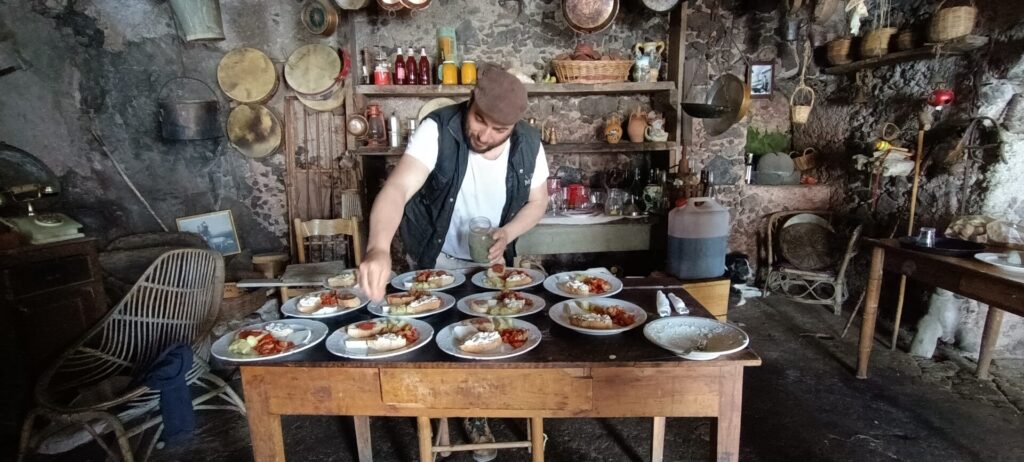
There is nothing polished about Antonio’s hospitality, and that is the point. He welcomes hikers because he enjoys telling his story and feeding the people who walked this far for it, not because he is running anything that resembles a commercial operation. Everything on the table comes from him or from the producers around him, and the long lunch carries the kind of conviviality that does not survive translation into paid hospitality. For clients who care about the distinction between a curated luxury experience and a participated one, his Refuge is one of the strongest examples we still have on this coast.
Lunch routes elsewhere for other clients. Sometimes that means a more conventional terrace restaurant in Nocelle, sometimes a Positano table for those returning by mid-afternoon, and sometimes a long lunch back at the property for the clients who prefer to come down from the trail and stop walking. Antonio’s table is the right answer for some of our clients, and we do not push it on the rest.
Where We Based the Group: Torre Sponda in Positano
The fam trip was organized by Torre Sponda, the boutique property in Positano we have been routing clients to consistently for several seasons now. The set-up of the trip allowed our team to combine a site re-inspection of the property with the wider Path of the Gods agenda over the same three days.
Torre Sponda sits in the upper portion of Positano, holding both the panoramic view that defines a stay in this town and the relative quiet that is much harder to find further down toward the beach. The footprint of the property is small, the service is direct rather than choreographed, and the kitchen runs on a rhythm closer to a private home than a hotel restaurant, anchored in seasonal Campanian produce that comes in mostly from a short radius around the building.
For the hiking-and-stay client profile we are formalizing more deliberately for 2026, the property’s geographic position matters operationally as well as aesthetically. Transfers to the Bomerano trailhead leave cleanly from the main road above town, which lets clients avoid the descent through the busiest pedestrian section of Positano that otherwise adds friction and twenty minutes of walking time during peak season. Returns from the trail drop hikers off at a level walkable to the property, without the famous and punishing Positano stairs that tired legs do not want at the end of a long walk. None of this is glamorous to write about, but it is the kind of detail that decides whether the hiking day reads as the highlight of the trip or as the moment the client noticed they were too tired to enjoy dinner.
The wider operator behind Torre Sponda also runs Palazzo Ripetta and Palazzo Scanderbeg in Rome. For our clients combining Amalfi Coast time with Roman base nights, which is a pairing we route frequently, the continuity of program standards across all three properties is something we plan around with confidence rather than treat as a happy coincidence.
“Three days on the coast did two things. They confirmed most of what we were already routing, and they refined the parts that needed adjusting. The trail came back as a stronger half-day anchor than I had been positioning it for advisors. The property where we were based holds its rhythm comfortably across three nights or four. And the partners we visited but decided against will not feature in our 2026 plans. That kind of editing is the real content of these trips, and the reason we keep coming back.”
— Laura, See Italy Travel Product Team
What Advisors Should Know
The Path of the Gods is the right addition for a particular kind of client. The profile is specific: someone who walks regularly at home and is comfortable enough on uneven ground to spend half a day on a trail that is not technical but is also not gentle. For clients whose Amalfi Coast priority sits in the iconic town circuit and the boat program around Capri, we continue to route Capri, the Furore Fjord, the Ravello villas and the coastal restaurants without bringing the trail into the conversation. Our position with the advisors we work with is direct: the trail is the right call for some clients and the wrong call for others, and we do not pretend otherwise. Getting that judgement right for each client, week by week, matters to us more than booking the same iconic walk into every Amalfi Coast itinerary we run.
🌿
Considering the Amalfi Coast for Your 2026 Italian Journey?
Our specialists build Amalfi Coast itineraries that pair the iconic coastal towns with on-trail experiences vetted personally by our product team. Every route reflects work done on the ground.
Logistics: Getting On and Off the Trail with a Luxury Itinerary
Most published guides on the Path of the Gods Italy are written for the independent hiker arriving by public transit, with the bulk of the content devoted to which SITA bus to take from Amalfi to Bomerano, where the local tobacco shop sells the bus ticket, and how to manage the return at the end of the day. For clients arriving on a private itinerary with a driver, the logistics work differently, and they are worth setting out plainly.
The standard run we route looks like this:
- Pickup from the property in Positano, or in Praiano or Amalfi depending on the itinerary, by 8:00 or 8:30 in the high-season months and earlier in summer to stay ahead of the heat
- Drive up to Bomerano, allowing 35 to 50 minutes from starting point depending on the day’s traffic; access on the SS366 narrows in several places, which is why we route this stretch with the small group of drivers who handle it regularly for us, rather than dispatching whoever is available on the day
- The walk, our loop version, takes around three hours of active walking from Bomerano along the ridge to the Refuge stop with Antonio at midday, and back along the same path to Bomerano
- Pickup at Bomerano by the same driver, with return to the property in Positano or onward to the next item on the day’s programming
Two variations on this run come up in client conversations and are worth noting plainly. The first is the longer route that continues along the full ridge from Bomerano through to Nocelle, which adds about an hour of walking and ends with a private vehicle transfer at the Nocelle road-end down to Positano. The second is the public stair descent from Nocelle to Positano on foot, roughly 1,800 stone steps in succession, which is technically possible but which we route only for clients who specifically ask and who are genuinely fit for sustained downhill stair work over a long stretch. Our regular guide partner on this stretch does not run the stair descent for clients as a default either, and our default does not include it. Most clients who hear an honest description of the steps choose the loop or the Nocelle-with-vehicle option instead, and the right walk is whichever one a client will finish in good shape for the rest of the day.
For multi-stop days, the more flexible return after the longer Nocelle variant is to come down to Positano by vehicle and continue by ferry, onward to Amalfi, Minori or Sorrento depending on where the rest of the afternoon programming sits. For Amalfi-based stays, the cleanest version of the day reverses the geography entirely: a morning ferry from Amalfi to Positano, followed by transfer up to Bomerano, turns what otherwise drifts into an afternoon of taxi-waiting into a properly contained half-day.
We push our Path of the Gods routings into the shoulder season. Late April into early June, and the second half of September through October, are the windows where the trail performs as the experience our clients are paying for. Summer brings two distinct issues: the heat across the long unshaded sections of the path, and a level of foot traffic that compresses the solitude the trail is best known for. We have written separately about the Amalfi Coast in August for clients whose calendar leaves them no other option, and we will route the trail in summer when a client specifically asks, but the shoulder-season months remain what we recommend on our own initiative.
Insider Note
The Path of the Gods is not in every Amalfi Coast itinerary we build, and we are direct with our advisors about that. For clients whose primary Amalfi interest is the coast itself, with its Capri boat days and Ravello terraces and the famous town circuit and the restaurants people read about, we route the trail as a possible add-on rather than a default. The trail goes into the itinerary when the client signal is clear: a regular walking habit at home, an actual interest in spending half a day away from the beach rhythm, a curiosity about how the coast looks from above the towns rather than within them. When those signals are absent, we book the week without the trail and neither client nor advisor misses anything. A strong Amalfi Coast week is entirely possible without this hike included. The point of putting it in, when we do, is that it gives clients something the rest of the coast cannot give them.
What This Adds to Our 2026 Amalfi Coast Offering
Our standard Amalfi Coast routings will continue to center on the iconic towns for clients whose interest is primarily Positano, Sorrento, Ravello and the boat program around Capri. That work is long-established and not changing. What our 2026 portfolio is now formalizing more deliberately, alongside that core, is a smaller set of routings shaped specifically by what three days on the trail and across the coast confirmed:
- Hiking-anchored stays at Torre Sponda or selected boutique partners, with the Path of the Gods Italy integrated as a half-day on the second or third morning of a multi-night stay
- Roma-Amalfi sequences that use Palazzo Ripetta or Palazzo Scanderbeg as the Roman base nights and Torre Sponda as the coastal nights, taking advantage of the continuity of operator standards across both legs
- Off-season Amalfi Coast itineraries built into the April-May and mid-September to October windows, pairing the trail with quieter town visits and shoulder-season pacing for clients whose calendar allows the flexibility
- Multi-coast Italian routes that pair the Amalfi with our work on the Ligurian coast further north, or that combine the south with Roman foundation time and a third region such as the Langhe or southern Tuscany for the right client profile
For clients planning a longer Italian journey, the Amalfi Coast integrates well into a two-week Italy itinerary that pairs southern coastal time with northern wine country or Tuscan countryside. Our upcoming Amalfi Coast advisor programming for 2026 will reflect this work directly. Spaces are limited, as they always are.
🍋
Building an Amalfi Coast Itinerary for 2026?
Our team designs Amalfi Coast routes shaped by years of work with the families and properties we trust. Each itinerary is built around the client, not the template.
Frequently Asked Questions About the Path of the Gods
What is the Path of the Gods?
The Path of the Gods Italy, in Italian Sentiero degli Dei, is a clifftop hiking trail on the country’s Amalfi Coast. It runs roughly 7 kilometers between the village of Bomerano, in the comune of Agerola, and Nocelle, a hamlet of Positano. The trail sits at approximately 630 meters above sea level and offers continuous panoramic views over the coast, sweeping from Praiano westward to Capri. Its name comes from local mythology, in which the gods are said to have walked this ridge to rescue Ulysses from the sirens of the Li Galli islets in the bay below.
How difficult is the Path of the Gods?
The Path of the Gods is rated easy to moderate, but the rating depends heavily on which version of the trail you walk. The loop we route for clients (Bomerano along the ridge to the Refuge stop and back to Bomerano) is the easier version: mostly flat to gently rolling, around three hours of active walking, with no long step descents. The longer route through to Nocelle adds about an hour and ends with either a private vehicle pickup at the Nocelle road-end or, for fit clients who specifically request it, a public stair descent of approximately 1,800 stone steps down to Positano. The full route in any version runs across uneven terrain, with several sections where the path narrows to less than a meter beside an exposed cliff drop. We recommend the standard loop for clients with a regular walking habit and no significant knee or vertigo issues, and we route the longer variants only on explicit request.
Is the Path of the Gods worth it?
For the right kind of client, yes; for the wrong kind, not really. The trail offers one of the longest uninterrupted panoramic stretches accessible on foot in southern Italy, and the perspective from the ridge cannot be reproduced from any of the coastal towns below. For clients whose Amalfi Coast interest sits squarely in the town circuit, the boats, the famous restaurants and the well-known viewpoints, the trail is optional and the week works without it. For clients who like to walk and who want the half-day above the towns, this is one of the experiences they will remember from their Italy trip more than most.
How long does the Path of the Gods take?
Our standard loop, from Bomerano along the ridge to the Refuge stop and back to Bomerano, runs around three hours of active walking; with a long lunch at Antonio’s Refuge midway, the full experience comes to roughly four to four and a half hours. The longer route through to Nocelle adds about an hour, ending with a private vehicle pickup at the Nocelle road-end. The public stair descent from Nocelle on foot, when a fit client specifically requests it, adds approximately a further hour of steep step-work down to Positano.
When is the best time to hike the Path of the Gods?
The most rewarding months are April through early June and mid-September through October. Spring brings wildflowers, mild temperatures and full visibility on a clear day. Autumn brings golden light and noticeably reduced foot traffic on the trail. Summer is technically possible, but the trail has minimal shade through its central sections and the high-season foot traffic compresses the sense of solitude that gives the walk its character. Winter walks can work in clear weather windows but require flexible scheduling around rain.
Do I need a guide for the Path of the Gods?
Many independent hikers walk the trail unguided, with route apps and local maps. For our clients, we route the trail with our regular guide partner on this stretch. The guide handles pace, route variations for different fitness levels and the timing alignment for the midway lunch stop at Antonio’s Refuge. More importantly, a guide turns the walk from a transit between two points into a reading of the territory itself, with the kind of local context our clients consistently report as the difference between a good half-day and a memorable one.
With love from the field,
The See Italy Travel Product Team
Ready to Build Your Amalfi Coast Itinerary?
From the iconic coastal towns to the trail that runs above them, we design Amalfi Coast routes shaped by years of on-the-ground work with the families and properties we trust. Let us talk about what the right Amalfi Coast looks like for your clients.
Are You a Travel Advisor?
We are actively refining our Amalfi Coast coverage through 2026, with the Path of the Gods now formalized more deliberately as a half-day anchor for the right client profile. If you place clients on this coast regularly, or if you would value early visibility into our 2026 partner programming, we would welcome the conversation. Our partnership program includes dedicated advisor support, competitive commission structure, and direct access to our product team’s territorial notes from trips like this one.
The Amalfi Coast is not a new region for us. It is one of the corners of Italy we work most often, and that is the very reason we keep returning to it in person, to make sure the experiences we are offering in 2026 are still the ones we would want our clients to live.
Go back